
Shopify cart abandonment from international customers is usually linked to problems at the final steps of the purchase journey, such as shipping costs and slow delivery. Language gets far less attention, even though it runs through every step, from understanding a product description to completing a checkout form or reading a follow-up email.
In this guide, we will clarify how strongly language influences buying decisions, then look at where the wrong language directly breaks the shopping journey, and show you how to close those gaps before BFCM.
Language decides whether international shoppers buy
Price and delivery get most of the attention in cross-border selling, but language decides whether shoppers understand what they are buying in the first place. The research below can help you judge how much of your international traffic depends on it.
Most shoppers prefer to buy in their own language
In a survey of 8,709 consumers in 29 countries, 76% said they prefer to buy products with information in their native language, and 40% said they will never buy from websites in other languages (CSA Research, 2020).
Language works much like distance. When eBay added machine translation for Spanish-speaking buyers, US exports on the platform to Latin America rose by more than 17%, an effect the researchers compared to cutting the distance between the countries by 37% (NBER, 2018). The gains were largest for products that need describing, such as clothing and jewelry, for items under $50 and for buyers with little experience, the kind of shoppers a BFCM sale tends to attract (FlavorCloud, 2025).

If language works like distance, translation is how you move your store onto the shopper’s street. Begin with the pages where the walk feels longest: products that need explaining, lower-priced deals, and the pages first-time international buyers land on.
A translated store can still lose the sale
Translation alone does not settle the matter. In a 2026 survey by digital experience platform Liferay of 800 US adults who use non-English websites, 56% said they had decided not to buy from a company because its site felt poorly adapted to their language, and 82% said they are confident they can tell when content was machine translated. Nearly half (48%) had chosen one company over a competitor because its website felt better adapted to their language and culture (Liferay, 2026).
Review quality where shoppers make up their minds, not only how many pages are translated. A product description or checkout message that reads like a rough machine draft signals low effort, and shoppers notice it at the moment they decide whether to trust you.
Where the wrong language drives cart abandonment for international customers
A store rarely fails in one place. Language gaps tend to appear at specific steps of the journey, and knowing where to look can help you fix the ones that cost the most orders first.
Product pages: Partial translation stops shoppers midway
When CSA Research asked shoppers about problems on sites translated into their language, 34% pointed to the quality of the content, 33% to missing localized help, and 26% to incomplete translation, and nearly half (48%) said they leave a site when they hit a problem (CSA Research, 2020). The same research found that 73% want product reviews in their language, even if nothing else is translated (CSA Research, 2020).
Translate the whole product page, including size guides, delivery notes, review content, and sale badges, not just the title and description. A page that switches back to English halfway down tells shoppers the rest of the experience may do the same.
Cart and checkout: Untranslated buttons, errors, and address fields
Shopify’s checkout has pre-translated content for 33 languages and is displayed in the language a customer uses to browse the store (Shopify Help, 2026). When translations do not exist, the store shows content in its default language (Shopify Help, 2026). In Liferay’s survey, 22% of respondents had seen buttons, menus, or error messages left in English, and 21% had seen dates, addresses, or phone numbers in the wrong format (Liferay, 2026).

Walk through the cart and checkout in each language you sell in, and check custom fields, error messages, shipping options, and anything added by apps. Language is only one part of checkout friction, and the price shown matters just as much, which we cover in our guide to currency at checkout.
Walk through the cart and checkout in each language you sell in, and check custom fields, error messages, shipping options, and anything added by apps. Language is only one part of checkout friction, and the price shown matters just as much, which we cover in our guide to currency at checkout.
Abandoned-cart emails: Reminders that arrive in the wrong language
When translations are available, Shopify sends order notifications in the language the customer placed their order in (Shopify Help, 2026). Marketing emails work differently: campaigns sent with Shopify Messaging go out only in the language you write them in and are not translated automatically (Shopify Help, 2026). Shopify’s help pages do not say which language abandoned checkout reminders use.
Test every reminder and campaign flow as a shopper in each language before BFCM. A French shopper who abandons a cart and then receives an English reminder is being asked to return to a store that has already shown it is not speaking to them.
Support and policies: Help in the shopper’s language keeps them buying
In CSA Research’s 2020 study, 75% of shoppers said they are more likely to buy from the same brand again if customer care is in their language (CSA Research, 2020). In Liferay’s 2026 survey, 35% wanted support from someone who speaks their language, and 23% had received support responses that felt machine-translated (Liferay, 2026).
Translate your shipping, returns, and refund policies, and prepare support replies for the questions BFCM shoppers ask most. If you use Shopify Inbox, note that its default chat greeting translates to the customer’s browser language, but a customized greeting does not (Shopify Help, 2026).
Close language gaps before BFCM
There is little time to fix a broken page once BFCM traffic arrives. The steps below use Transcy to close most of the gaps covered above, with the plan for each feature needed, so every market gets a complete experience before the November rush.
Translate the full path, not just the homepage
Follow the three steps below to make sure your whole store is translated.
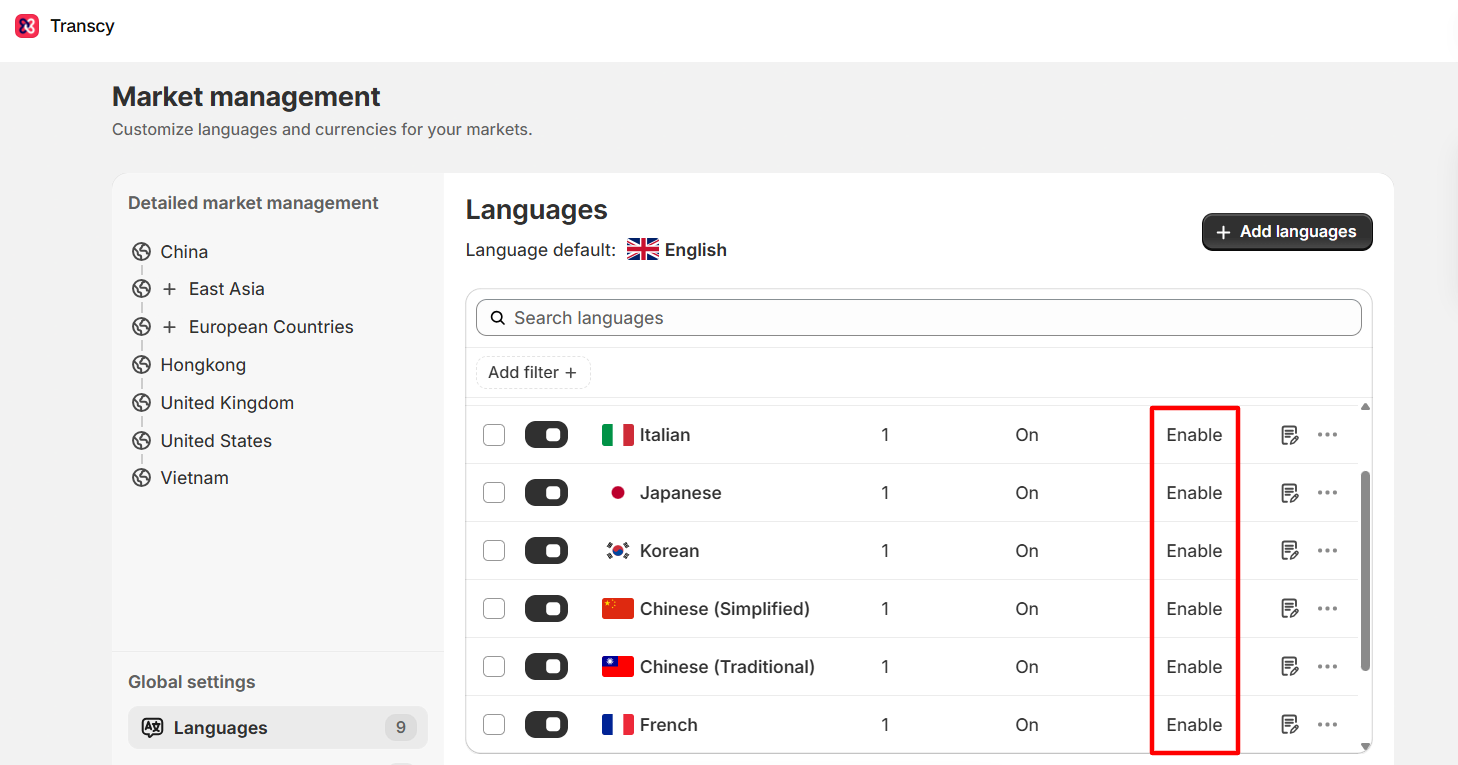
Step 1: Make sure to use editable languages
Editable languages save your translations in Shopify’s own language system, so you can translate with AI engines and have full control over editing them, from the homepage to checkout.
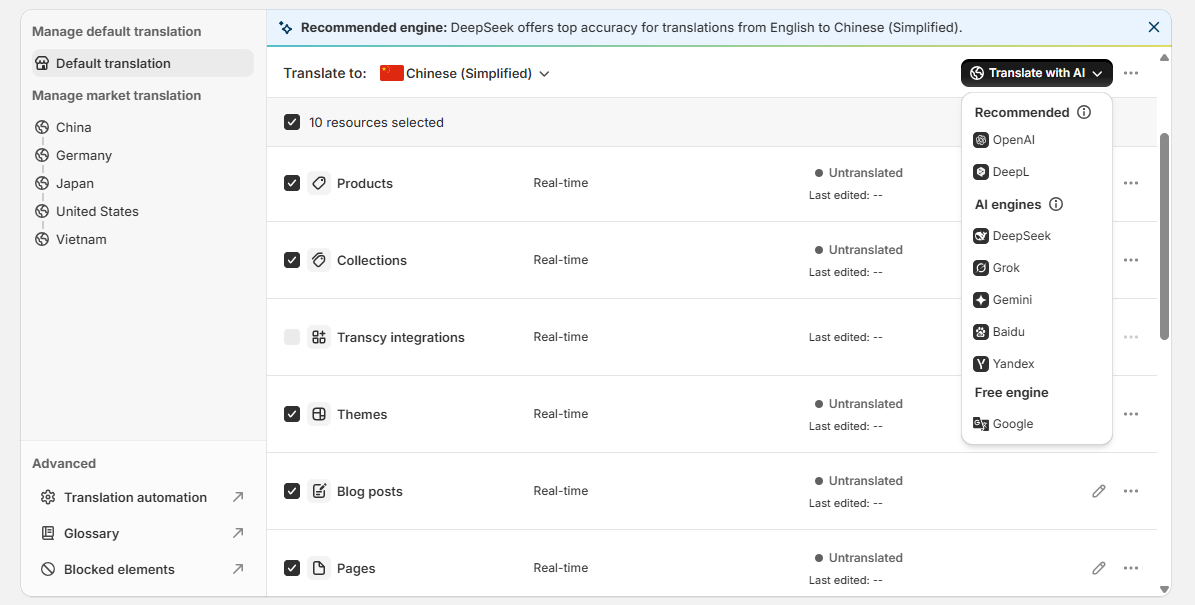
Step 2: Translate all resources with the right AI engine
Choose an engine, and bulk translation covers your store’s resources at once. Transcy offers seven AI engines and language models, and some work better for certain language groups, such as DeepL for European languages or Yandex for Russian.
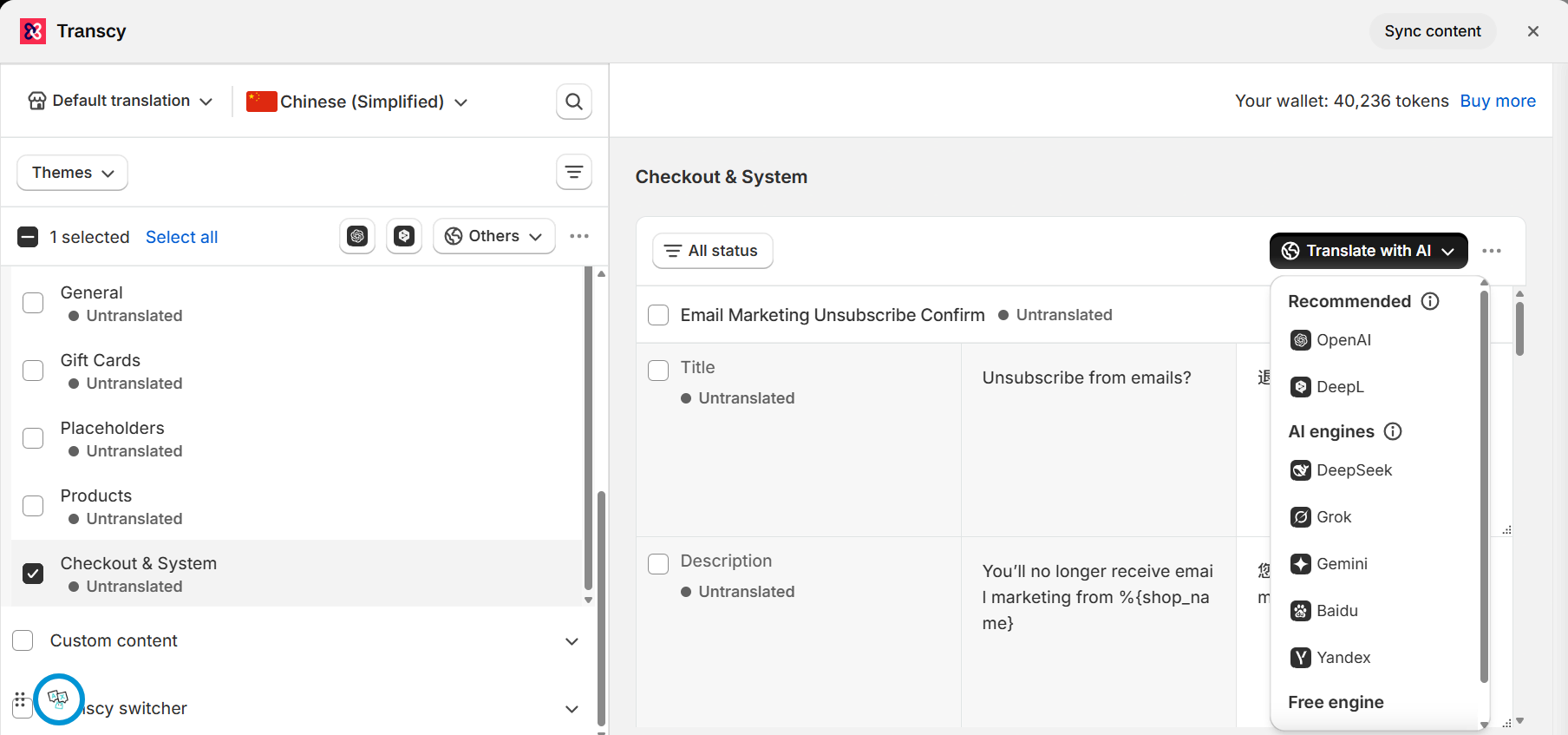
Step 3: Translate checkout as a separate step
Due to a Shopify limit, checkout content cannot be covered by bulk translation, so you need to translate it separately in the Checkout & system section of your theme content.
Keep your brand voice consistent
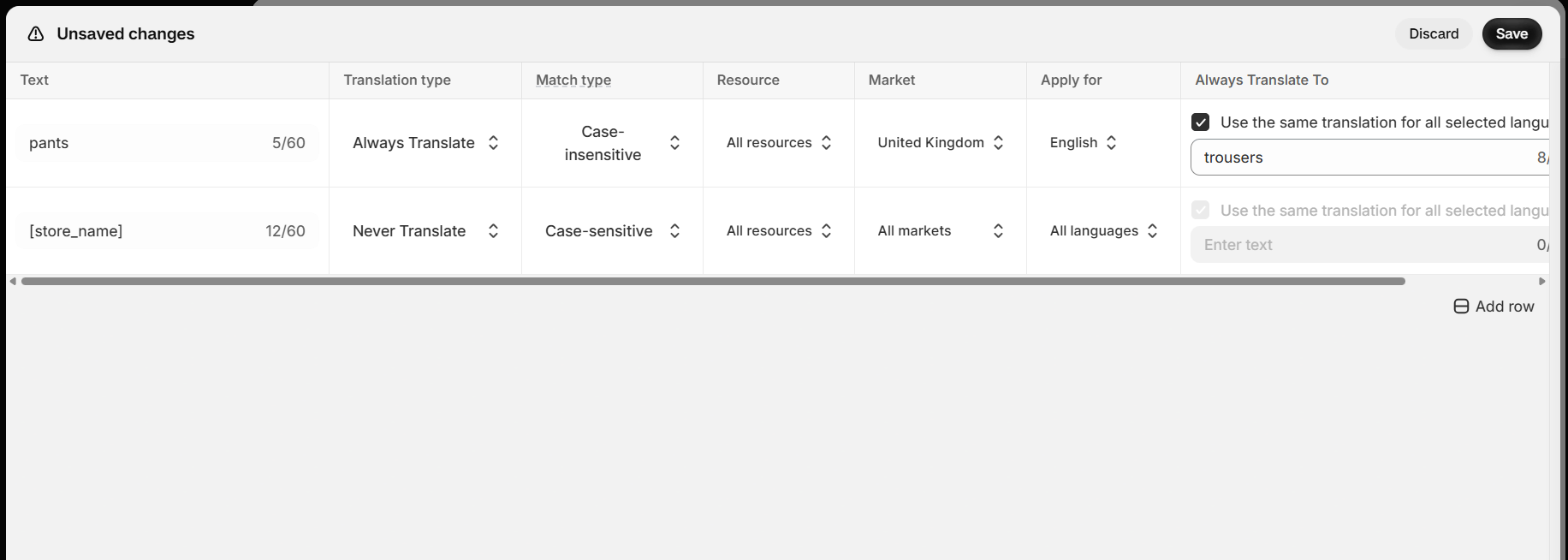
Before you let AI translate your whole store, set rules for your brand assets, such as your brand name, product names, sizes, and other fixed terms, so the AI does not turn them into odd translations you never intended.
In Transcy, the glossary lets you mark a term as ‘Never translate,’ so it stays exactly as written, or ‘Always translate,’ so it always becomes the specific term you choose.
Show shoppers their language as soon as they arrive
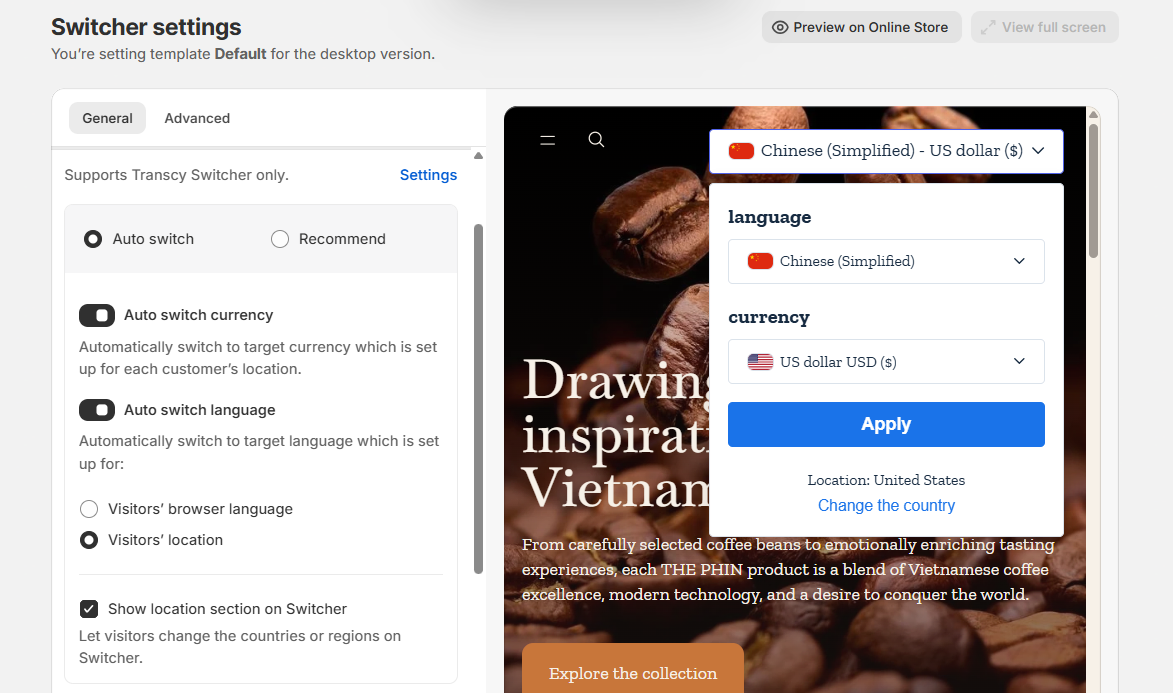
If international shoppers still leave after you have translated everything, they may simply have lost patience before finding your language switcher.
Transcy’s geolocation can switch the language and currency automatically or show a pop-up that recommends them, based on each visitor’s location or browser language.
Conclusion
The numbers above show how strongly language influences buying decisions, at every step from the product page to the checkout. We hope the steps in this guide help you get it right before BFCM, so you do not lose a single visitor to the wrong language during the busiest weeks of the year.

"The best Shopify translation and localization app designed to help merchants expand globally by translating their store content into multiple languages and adapting it to different currencies and markets."


Table of Contents
Read more articles
Currency Shock at Checkout: The Silent BFCM Conversion Killer
By Transcy Aug 15, 2024
"The best Shopify translation and localization app designed to help merchants expand globally by translating their store content into multiple languages and adapting it to different currencies and markets."